

Holiday Marketing: 7 Budget-Friendly Ideas for Shops
I’d start holiday marketing with two or three ideas – not seven at once. Pick in-stock gifts, set a spending limit, and build around Small Business Saturday on November 28, 2026.
Here are the seven options I’d choose from:
- A holiday window display: Show gift picks with clear prices.
- Facebook and website updates: Share stock, hours, and pickup details.
- Gift guides: Help shoppers choose with 5–8 products per guide.
- Targeted emails: Send gift ideas to subscribers based on their interests.
- Gift bundles: Package products into ready-to-buy sets.
- Nearby business offers: Share a simple deal with a local partner.
- A small shopping event: Give shoppers a reason to visit and buy.
My rule: <u>count supplies, discounts, and staff time before launching</u>. Then track sales each week, stop sold-out offers, and shift to local pickup and gift cards when holiday shipping deadlines pass.
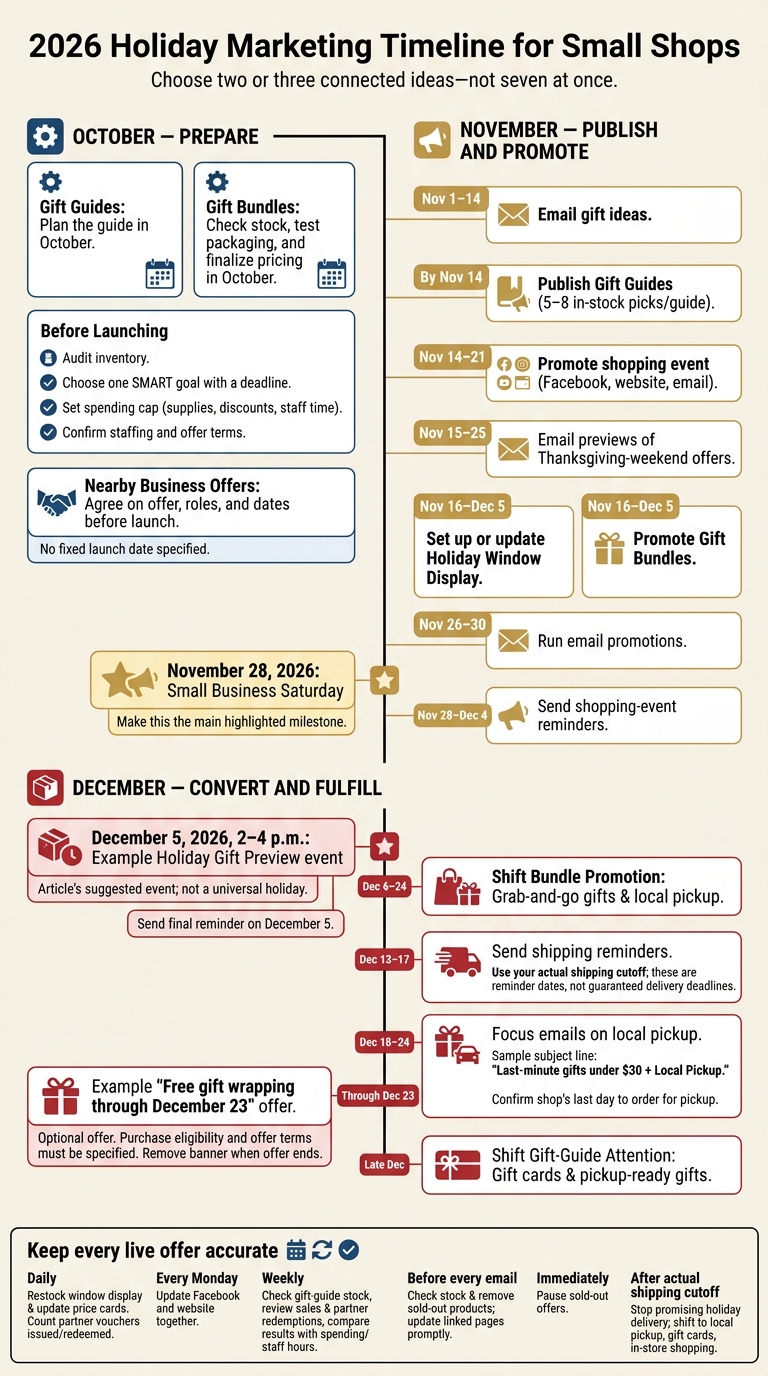
2026 Holiday Marketing Timeline for Small Shops
Set Your Holiday Goal, Budget, and Schedule
Start with an inventory audit. Promote only what you can sell or fulfill. Count holiday stock, set aside products reserved for pickup orders, and check that advertised quantities match what your team can handle.
Choose one SMART goal with a deadline. Make sure it’s realistic for your stock levels and staffing.
Set a spending cap that covers printing, postage, discounts, and staff time. Estimate how many extra orders you’ll need to break even without cutting too far into your margins.
Lock in staffing and offers before the holiday rush. Post your in-store holiday hours, Black Friday offer, and community-focused Small Business Saturday message. Time December reminders around those hours and pickup deadlines. Once your shipping cutoff passes, stop promising holiday delivery.
Keep seasonal messages specific: use product names, prices, and deadlines rather than vague holiday cheer. Track each channel with its own offer code, redeemed referral cards, or a simple question at checkout. Record results next to spending and staff hours so you can see which efforts paid off.
Your window display is the easiest low-cost place to start bringing in shoppers.
sbb-itb-303bd8e
1. Create a Holiday Window Display
Local shopper appeal
Give local shoppers a reason to step inside before they spot holiday offers elsewhere. Make “Gifts Under $25” the main window message. Group in-stock items by recipient: “For the Host,” “For Kids,” or “For Pet Lovers.” Add large, handwritten price tags so shoppers can check prices at a glance.
Use kraft paper, reusable decor, and string lights to frame one focal point, and add a staff pick card beside the featured gift.
Costs, inventory, and staffing
Keep materials under $100 by reusing decorations and choosing simple lighting. Include setup and upkeep in your labor budget. Assign one person to restock sold items and update price cards daily.
Launch steps and timing
Set up or update the display between November 16 and December 5. Before adding a sidewalk sign or window poster, check local sign rules and confirm where placement is allowed. Photograph the finished display to reuse in your Facebook and website updates.
2. Update Facebook and Your Shop’s Website
Local shopper appeal
Use the products and photos from your window display on Facebook and your website, too. Keep all three in sync so local shoppers can check what’s in stock before stopping by.
Update your existing Facebook account and website with current products, holiday hours, and pickup instructions. Post new smartphone photos of in-stock items and staff filling orders. Showing what’s ready now helps shoppers decide what to buy before they visit.
Holiday promotion example
Put Free gift wrapping through December 23 on both your Facebook post and homepage banner. Use the same photo of staff wrapping a stocked product, and explain which purchases qualify and how customers request wrapping.
State whether the offer applies to in-store purchases, online purchases, or both. Stick to one offer and one call to action.
Costs, inventory, and staffing
Posting costs little, but gift wrapping takes supplies and staff time. Budget for paper, ribbon, tape, and labor. A basic wrapping station can cost $100–$1,000, depending on scale and materials used. Plan the offer around your busiest shifts so staff can keep up.
Launch steps and timing
Use this quick publishing checklist:
- ☐ Photos: Take clear smartphone shots of current stock.
- ☐ Accounts: Update Facebook and your website together.
- ☐ Early post: Publish a holiday preview.
- ☐ Weekly update: Update both channels every Monday.
- ☐ Confirm: Check holiday hours, pickup instructions, and offer deadlines before publishing.
Post one last reminder before the deadline, then remove the banner when the offer ends. Once shoppers know what you carry, use gift guides to turn that interest into sales.
3. Create Gift Guides With In-Stock Products
Local shopper appeal
Make your in-stock products an easy shopping guide for people who need gift ideas fast. Build on your window display and website updates to help shoppers go from browsing to buying.
Group gifts by recipient, interest, occasion, or price – “Gifts for Teachers,” “Pet Lovers,” “Host Gifts,” and “Under $50” – so shoppers can narrow choices fast.
Give each item one photo, a one-line description, and a price.
Holiday promotion example
Build each guide around 5–8 in-stock picks, not your whole catalog. Add “Staff Picks” with handwritten staff notes. Keep printed copies at checkout so staff can help indecisive shoppers and raise the average sale.
Costs, inventory, and staffing
Before picking products, assign one staff member to review inventory reports, recent sales, and supplier lead times. Choose items with steady stock that you can restock fast.
| Format | Typical extra cost | Setup time | Best use |
|---|---|---|---|
| One-page handout | $20–$50 for printing | 2–3 days | Checkout copies and shopping-bag inserts |
| PDF or webpage | $0 using your existing site | 1–2 days | Email links and browsing before a visit |
| Facebook post series | $0 for organic posts | 30 minutes per post | Highlighting individual picks for local followers |
Launch steps and timing
Plan your guide in October and publish it by November 14. Check featured stock weekly, and remove sold-out items from both digital and printed copies. In late December, shift attention to gift cards and pickup-ready gifts.
Use the same product picks in your holiday emails and social posts so shoppers see a consistent offer.
4. Send Targeted Holiday Emails
Local shopper appeal
Turn products from your gift guides into targeted emails. Send only to subscribers who’ve given permission, and group recent buyers and top spenders by product category. Match offers to their interests to help turn browsing into purchases.
Holiday promotion example
For December 18–24, use the clear subject line “Last-minute gifts under $30 + Local Pickup.” Include photos and prices for three currently in-stock products, holiday hours, pickup instructions, and the last day to order for pickup. Keep the message focused on gifts shoppers can still get locally.
Keep product names and prices consistent with your gift guides.
Costs, inventory, and staffing
Use your existing email software and product photos. Budget 2–5 staff hours and under $100 in added costs. Check stock before every send, remove sold-out products from later emails, and update linked pages right away.
Launch steps and timing
Send gift ideas November 1–14, then preview Thanksgiving-weekend offers November 15–25. Run promotions November 26–30, including Small Business Saturday on November 28.
Send shipping reminders December 13–17, then focus on local pickup December 18–24.
Process unsubscribes automatically. Track offer redemptions and pickup orders to see which emails bring shoppers in.
Use these emails to point shoppers toward simple bundle offers next.
5. Put Together Affordable Gift Bundles
Local shopper appeal
Turn your best gift-guide items into ready-to-buy gift sets for last-minute shoppers. Pair a bestseller with a useful accessory or a slow-moving item to offer more value without storewide markdowns.
Holiday promotion example
Offer a “Cozy Morning” set with a mug, locally made coffee, and a gift card, priced at $25 or $35, based on your costs and target margin.
Clearly show the contents and gift card value so shoppers know exactly what they’re buying.
Costs, inventory, and staffing
Before setting a price, add up product costs, the gift card value, packaging, and assembly labor. Build one sample, then prepare a limited batch based on your stock and staff time. Keep packaging costs down with simple tissue or a printed belly band.
Launch steps and timing
Use October to check stock, test packaging, and finalize pricing. Promote bundles from November 16–December 5, then shift to grab-and-go gifts and local pickup from December 6–24.
Share the bundle photo and price across your channels. Give each bundle a clear price tier, such as “Under $25” or “Under $50.”
Bring the same bundle offer into your local partnerships.
6. Plan Joint Offers With Nearby Businesses
Local shopper appeal
A joint offer with a nearby business that serves the same shoppers can double your reach without doubling your budget. A bookstore and café make a natural pair: shoppers can buy a gift, then stop for a drink. Start with one partner and keep the offer simple enough for both teams to explain in seconds.
Holiday promotion example
Offer 15% off a latte with a $25 book purchase. Customers buy at the bookstore, receive a voucher, and redeem it at the neighboring café’s checkout. Use the same headline everywhere: Buy a Book, Get 15% Off Your Latte.
Costs, inventory, and staffing
Confirm who handles what in a short email. The bookstore supplies vouchers and manages book stock. The café covers the discounted drink, ingredients, and counter staffing. Split printing costs equally; shared print materials start at approximately $21.97.
Launch steps and timing
Agree on the offer, roles, and dates before launch. Promote it on both businesses’ Facebook pages, websites, and register signs, and train both teams to explain it. Count vouchers issued and redeemed daily. Review redemptions weekly to see which partner drives sales. Once the partnership is running, use that same foot traffic for a small in-store event.
7. Host a Small Holiday Shopping Event
Local shopper appeal
Turn traffic from joint promotions into store visits with a small holiday event, such as gift-wrapping demos. Choose one goal, like selling in-stock gift bundles, to keep the event focused. Stick to products you already stock to control costs and make the event easy to repeat.
Holiday promotion example
Plan a Holiday Gift Preview on Saturday, December 5, 2026, from 2–4 p.m. Include gift-wrapping demonstrations, refreshments, and a limited-time offer on available gift bundles. Display only products shoppers can buy that day, and clearly state when the offer ends.
Costs, inventory, and staffing
Set a spending cap for refreshments and signs before buying supplies. Choose prepackaged refreshments and follow local food-safety requirements. Assign current staff to demos, checkout, and floor coverage so regular service continues. Keep entrances and aisles clear, and stay within store capacity limits.
Launch steps and timing
Promote the event from November 14 to 21 on Facebook, your website, and your email list. Send reminders from November 28 to December 4, followed by a final reminder on December 5.
Track event purchases in your checkout system. Afterward, use a spreadsheet to record units sold, leftover stock, and fastest sellers. Compare those results with your original goal.
Conclusion: Start Small and Repeat What Works
Start the season with ideas most likely to move inventory. Launch two or three connected ideas first.
Pair a window display with a QR-linked gift guide, then echo it on Facebook and your website.
A few channels working together will outperform too many scattered campaigns.
Use one master checklist for stock, hours, and offer terms to keep live offers accurate. Keep approved graphics in a shared folder so staff can find and reuse them fast.
Review sales, redemptions, and customer questions each week, then move budget toward the best-performing channels. When the data shows what’s working, keep promoting it and drop anything that no longer applies.
Pause sold-out offers immediately and clearly label any replacement. Move the remaining budget toward gift cards, local pickup, and in-store shopping.
FAQs
Which holiday promotions best fit my shop?
Choose promotions using three filters: customer fit, staff capacity, and profit margins. Do your shoppers want convenience, such as gift wrapping or curated bundles? Or do they prefer exclusive access and community events? Pick offers your team can handle during busy weeks.
To protect margins, favor gift-with-purchase offers or loyalty rewards over blanket discounts. Track results with links or codes so you can measure what works and use those results to improve next season’s promotions.
How do I price gift bundles profitably?
Focus on increasing your average order value, not offering deep discounts. Pair slower-moving inventory with bestsellers to clear stock and sell more items with each purchase.
Protect your margins with modest savings on the bundle’s total price instead of a flat percentage discount. Offer good, better, and best options with clear price cards to steer customers toward bundles that meet your profit goals.
How can I tell if holiday marketing pays off?
Set clear, measurable goals before launching campaigns. Track purchases and repeat business – not likes or follower counts. Use campaign-specific promo codes, point-of-sale transaction tags, and UTM links to connect each campaign to its results.
Start digital ad tests with small daily budgets. Set an impression benchmark in advance, and stop ads that reach it without driving consistent actions. Judge new customers by their long-term value, not just their first purchase.


